
Turkey's Tourism-Purpose Residential Rental Permit: A Complete Guide for Property Owners
If you own a property in Turkey and are considering listing it on Airbnb or a similar short-term rental platform, there is one legal requirement you must address before accepting your first guest: the Tourism-Purpose Residential Rental Permit (Turizm Amaçlı Konut İzin Belgesi).
Introduced through legislation enacted in 2023, this permit is now mandatory for any residential rental of fewer than 100 consecutive days. Operating without it exposes property owners to significant financial penalties and the removal of their listings from major platforms. This guide walks you through everything you need to know — from what the permit is, to how to apply, to what happens after approval.
What Is the Tourism-Purpose Residential Rental Permit?
The Tourism-Purpose Residential Rental Permit is the official authorisation issued by the Turkish Ministry of Culture and Tourism that allows property owners to legally rent their homes on a short-term basis.
Without this permit, any rental arrangement of under 100 days is considered unlawful under Turkish law. The permit serves three primary purposes:
• It enables property owners to publish and maintain active listings on platforms such as Airbnb and Booking.com.
• It fulfils the legal obligations imposed by the 2023 short-term rental regulations.
• It provides a formal basis for resolving potential disputes with building co-owners or management.
Step-by-Step Application Process
The application is submitted entirely online through Turkey's e-Government portal (e-Devlet). When approached methodically, the process is straightforward.
1. Log in to your e-Government account (E-devlet)
Access the portal at e-devlet.gov.tr using your Turkish identity credentials. If you are a foreign national, you will need a Turkish tax identification number and a registered e-Government account.
2. Locate the relevant service
Search for the service titled "Konutların Turizm Amaçlı Kiralanması İzin Belgesi" (Tourism-Purpose Residential Rental Permit for Homes) and select it to begin your application.
3. Obtain a UETS address (if not already registered)
A UETS (Ulusal Elektronik Tebligat Sistemi — National Electronic Notification System) address is mandatory for this application. If you do not already have one, it can be obtained free of charge through your e-Government account or at any PTT branch across Turkey.
4. Complete and submit the application form
Fill in all required fields accurately. Incomplete or inaccurate entries are among the most common causes of delays. Upload the required supporting documents (detailed in the section below) and submit your application.
5. Pay the application fee
Following submission, you will have 15 days to pay the applicable application fee. Failure to pay within this window will result in automatic cancellation of your application, requiring you to restart the process from the beginning. Fee amounts are updated annually and published in the Official Gazette (Resmî Gazete); verify the current rate prior to applying.
6. Await approval and your permit number
If your documentation is complete and correct, an initial decision is typically issued within three working days. Once payment is confirmed, your permit number is generally generated within a further two to three days. End-to-end, a complete application with no deficiencies can be resolved in approximately seven days.
Required Documents
Submitting a complete set of documents from the outset is the single most effective way to prevent delays or rejection. The following are required:
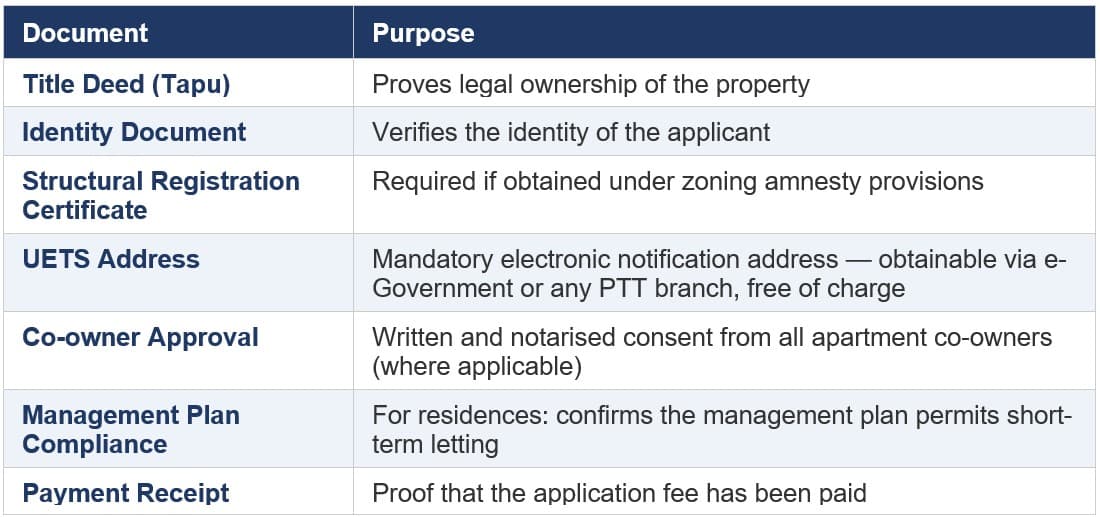
Important note for apartment owners: Standard apartment blocks typically do not have a formal management plan. In these cases, written consent from all co-owners is required. This consent must be recorded in the building's resolution register and notarised. If no such register exists, individual notarised declarations from each co-owner are required. For residences (rezidans), the building's management plan takes precedence; if it explicitly permits short-term letting, separate co-owner consent is not necessary.
The Plaque/Plate Process
Once your permit number has been issued, you are legally entitled to begin rental activity. However, the process does not end there.
• The Ministry of Culture and Tourism will dispatch an official metal plaque to your address. Delivery typically takes between one and three months from the date of permit issuance.
• Upon receipt, the plaque must be affixed at the entrance to your property. This is a legal requirement, not optional.
• In the interim period before the plaque arrives, the Ministry issues a provisional PVC-covered document confirming that the permit process has been formally initiated. This provisional document satisfies the display requirement until the permanent plaque is received.
After Approval: What to Do Next
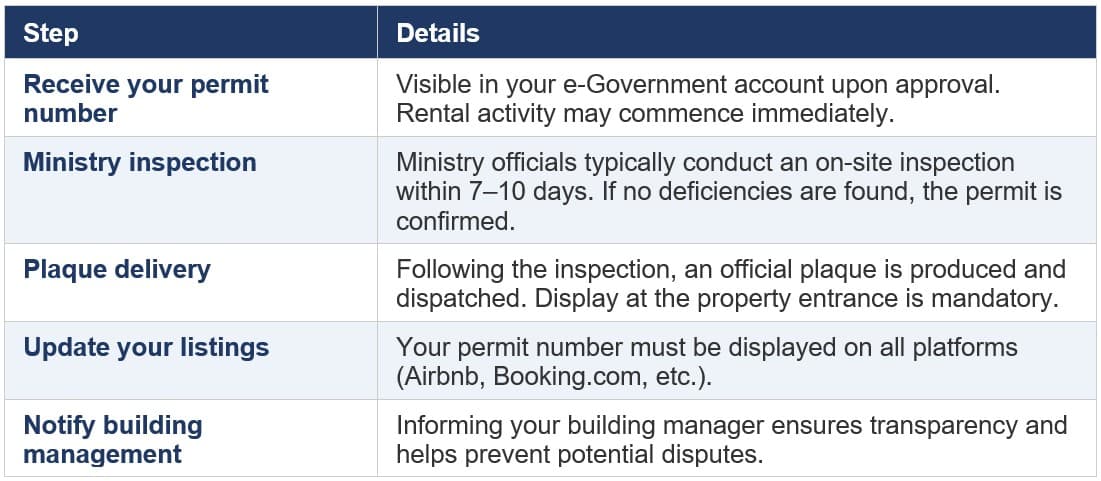
Receiving your permit number is the beginning of your obligations as a licensed short-term rental operator, not the end. The table below summarises the key steps to take following approval.
Consequences of Operating Without a Permit
The risks of non-compliance are material and should not be underestimated.
Financial penalties
Administrative fines are applied from the first instance of non-compliance. For repeat violations, penalties increase cumulatively. In severe cases, rental activity may be prohibited entirely.
Listing removal
Platforms including Airbnb and Booking.com are required to remove listings that do not display a valid permit number. Operating without a permit therefore directly undermines your ability to generate rental income.
Legal and neighbour disputes
Complaints from neighbouring residents or building management can escalate into formal legal proceedings, adding reputational and financial risk.
Long-term income loss
While unlicensed operation may appear to generate short-term income, the cumulative cost of fines, listing removal, and potential legal action invariably outweighs any initial savings.
Frequently Asked Questions
How long does the permit take to obtain?
With a complete set of documents, the process typically concludes within seven to ten days.
How long is the permit valid?
The permit does not expire. It remains valid indefinitely unless revoked following a substantiated complaint, a regulatory violation, or at the owner's own request.
Can I begin renting before the plaque arrives?
Yes. Once you have received your permit number, you may lawfully commence rental activity. The provisional document issued in the interim satisfies the display requirement until the permanent plaque is delivered.
What if the annual fee changes?
Application fees are revised annually and published in the Official Gazette. Always verify the current rate immediately prior to submitting your application to avoid processing delays.
What does the Ministry inspection involve?
Ministry officials will visit the property — typically within seven to ten days of permit issuance — to verify that the premises meet the required standards. If no deficiencies are found, the permit is formally confirmed.
Ready to let your property — legally and confidently?
Navigating the permit process, co-owner approvals, and listing compliance can be time-consuming. Our team at INDIGO Property Management provides professional support at every stage, from document preparation through to active listing management, so you can focus on your guests, not your paperwork.
Get in touch to discuss how we can help you get started.